


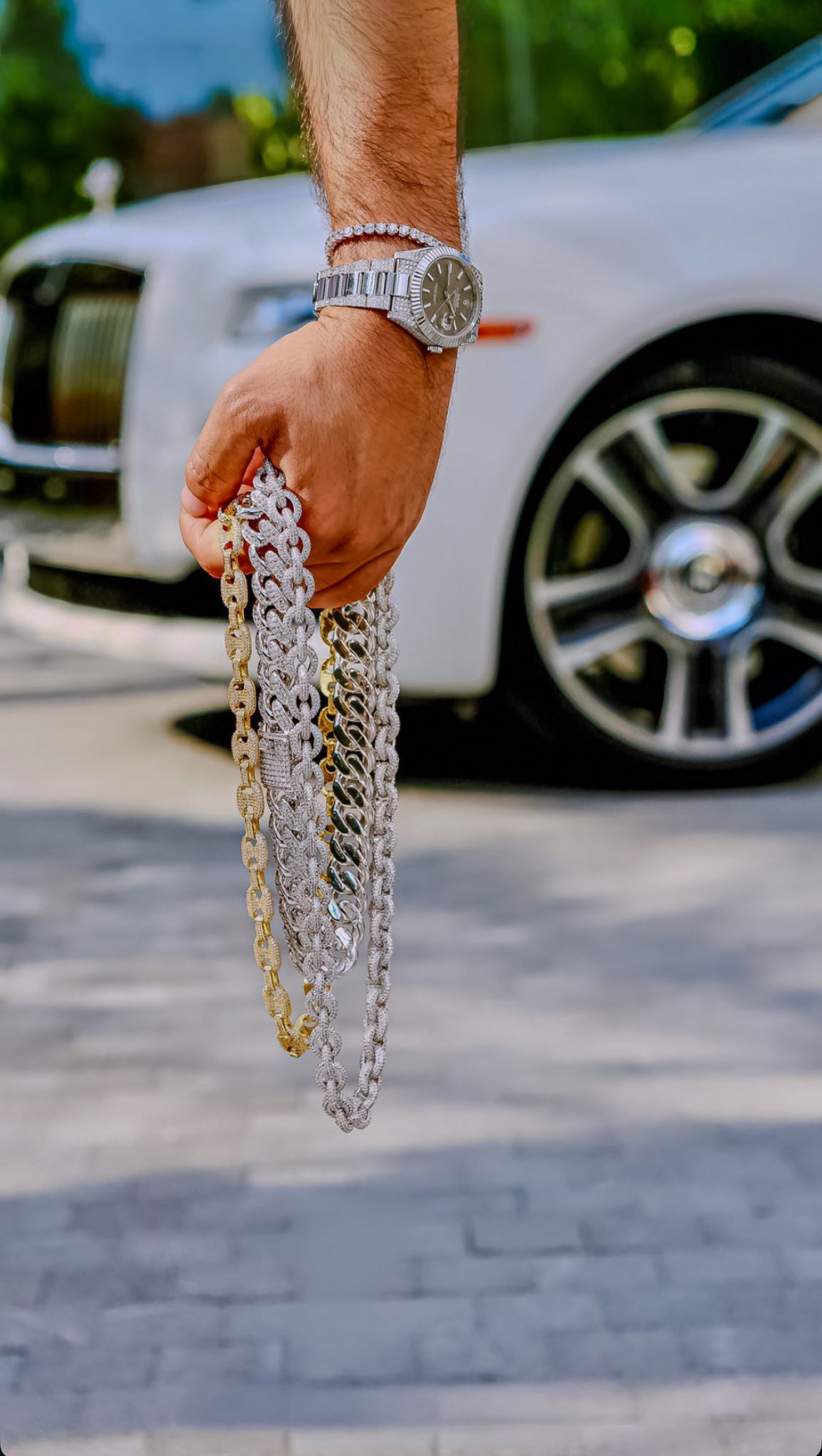

The iced-out chain market is full of pieces that look great in photos and fall apart in three months. Here are the five tests every buyer should run before paying.
Test 1: How are the stones set?
This is the single most important test. Real iced-out pieces have stones in individual prong settings. Each stone has 4 small metal prongs gripping its sides, holding it in place mechanically.
Cheap copies use one of two shortcuts:
- Channel-poured glue. The factory pours adhesive into the metal channel and presses stones in. Quick, cheap, falls apart in months.
- Pressed bezels. The metal is bent around each stone without true prong settings. Looks decent at first, loses stones when bent.
Hold the chain at an angle and look closely. Real prongs are visible: 4 tiny metal points around each stone. Glued stones look like the metal flows continuously around them.
Test 2: Squeeze the clasp
A real cuban link clasp is a heavy box clasp with a tongue mechanism that locks flush with the chain. It is the heaviest single point on the chain.
Counterfeit clasps are usually:
- Lobster claws on cuban-style chains (wrong style for the heritage cut)
- Lightweight box clasps that bend when pinched
- Plastic-feeling tongues that don't snap with confidence
Squeeze the clasp between your thumb and forefinger. If it feels hollow or flexes, the construction is cheap.
Test 3: Weight check
Solid construction has weight. A 22-inch 12mm cuban link should weigh 60 to 80 grams. If the chain feels lighter than expected for its size, the metal is hollow or thin.
The math: density of brass is 8.4 g/cc, gold is 19.3 g/cc. A real solid gold piece feels noticeably heavier than the same shape in plated brass. A real plated piece feels noticeably heavier than the same shape in pot metal.
When you pick up a chain and it feels weightless, walk away.
Test 4: Plating finish
Real 18K gold plating has depth. The yellow tone is rich, the highlights catch light without distorting it, and the surface is smooth.
Cheap plating shows up as:
- Streaks or uneven color across the chain
- A slight pink or copper tint underneath the gold
- Visible "orange peel" texture under bright light
- Fingerprints showing through after handling
Run your finger along a few links. If your skin leaves a visible mark, the plating is too thin and will wear off in weeks.
Test 5: Link consistency
Pull the chain out straight and look at the link pattern. Every link should be identical in size, shape, and angle. The chain should lie flat on a surface without curling or twisting.
Counterfeit chains often have:
- Slight variations in link size (machine-stamping was rushed)
- Visible weld marks on individual links
- A chain that rolls instead of lying flat (links don't interlock properly)
A real cuban link chain has 100+ identical interlocking pieces. The factory either gets every one right or none of them right.
Pro tip: the fastest single test is the clasp squeeze. A confident, heavy, snap-locking box clasp tells you the maker cared about the rest of the chain too. A flimsy clasp tells you the rest is also cheap.
Bottom line
If a chain fails 2 or more of these 5 tests, walk away. The piece will not last and the seller knows it.
Every SKRT chain passes all 5: hand-set prong stones, heavy box clasps, weighed-to-spec construction, 18K plating tested for daily wear, and link patterns inspected at the bench. See the cuban link collection for full construction specs on every piece.
Share:
Chain Width Guide: 8mm to 18mm Cuban Link Compared
Yellow Gold vs White Gold vs Rose Gold: Which Suits You