

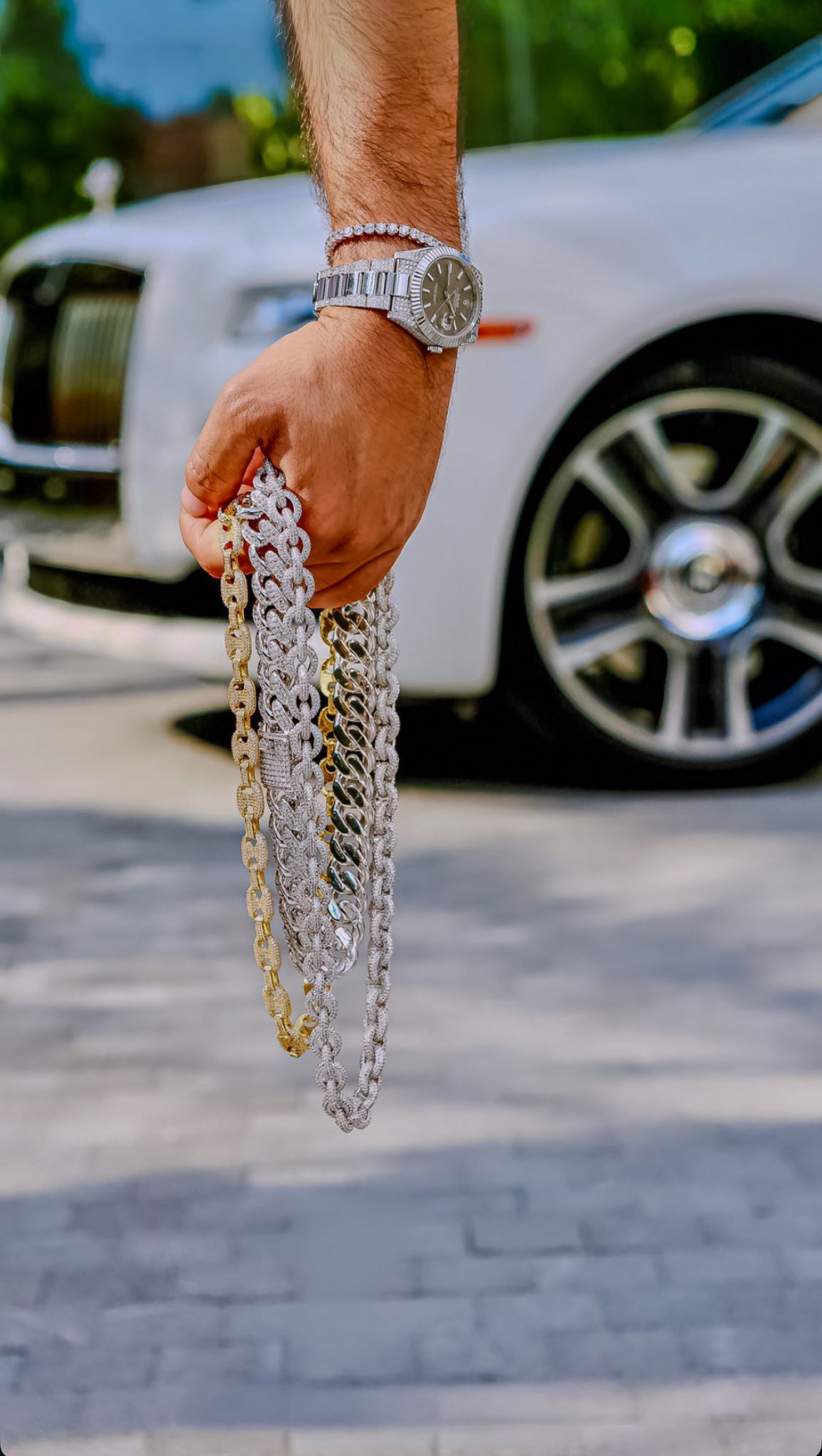

Color. Clarity. Cut. Carat. The 4 Cs are how the jewelry industry grades every diamond, lab-grown or natural. Here is what each one means when you are shopping iced-out hip-hop pieces specifically.
Carat: the weight, not the size
Carat is a unit of weight, not size. One carat equals 0.2 grams. So a 1-carat diamond and a 1-carat collection of small stones in a tennis chain weigh the same, but look very different.
For iced-out pieces with hundreds of small stones, total carat weight (TCW or CW) matters more than individual stone size. A 22-inch 12mm cuban link with prong-set 1.5mm stones might hold 8 to 12 carats total.
What to look for: pieces with stated TCW. If the listing only says "diamond-set" without a carat figure, the maker is hiding something.
Color: how white the stone reads
Color is graded D (colorless) through Z (heavily yellow). D, E, and F are colorless. G through J are near-colorless. K and below show visible warmth.
For iced-out pieces, the practical sweet spot is G to H. Stones in this range read as white in normal light but cost significantly less than D-F. Most viewers cannot tell the difference between an H-color stone and an F-color stone in a finished piece without a jeweler's loupe.
What to avoid: pieces that don't disclose color grade. If the listing doesn't say D-F, G-H, or similar, assume the maker is using lower-grade stones (J or worse) and hiding it.
Clarity: how clean the stone is internally
Clarity grades how many internal flaws (inclusions) and surface flaws (blemishes) a diamond has. The scale runs FL (flawless) through I3 (heavily included).
For iced-out hip-hop pieces, the relevant range is VS1, VS2, SI1, and SI2.
- VS1 to VS2: very slightly included. Inclusions visible only under 10x magnification. Best balance of look and price for hip-hop pieces.
- SI1 to SI2: slightly included. Inclusions sometimes visible to the naked eye on close inspection, especially in larger stones.
Below SI2 (I1 and worse) is when inclusions become visible to the casual viewer. Avoid for visible-stone pieces, acceptable for tiny accent stones.
What to look for: VS1-VS2 grading is the sweet spot for iced-out pieces under 1 carat per stone. Anything above is overkill on a piece you wear daily.
Cut: how well the stone is shaped
Cut is the only one of the 4 Cs that is purely a workmanship grade. It measures how precisely the stone was cut to maximize light return. The scale: Excellent, Very Good, Good, Fair, Poor.
For iced-out pieces with hundreds of small stones, you want at least Very Good cut. Excellent is only worth paying for on the larger center stones (pendant focal points, statement rings).
Why cut matters: a poorly-cut diamond doesn't sparkle no matter how high-grade the color or clarity. Cut is what turns a stone into "ice".
Lab vs natural
Lab-grown diamonds are physically, chemically, and optically identical to natural diamonds. They are graded on the same 4 Cs by the same labs (GIA, IGI, GCAL).
The difference is price. A 1-carat lab diamond costs roughly 30 to 50 percent of a comparable natural diamond. For iced-out hip-hop pieces with hundreds of small stones, this is the math that makes the look reachable.
SKRT iced-out pieces use hand-set 5A cubic zirconia, the highest CZ grade. Every product page says exactly what is in the piece.
Pro tip: at hip-hop jewelry price points (under 5,000 dollars), the realistic range for iced-out cuban links and tennis chains is high-grade CZ or moissanite. Anyone selling "iced-out diamond" pieces in this price range is either lying or losing money. Honesty about stone material matters.
Bottom line
For iced-out pieces, look for pieces that disclose: TCW, color grade (G-H minimum), clarity (VS to SI1 range), cut (Very Good or better), and stone material (lab diamond, moissanite, or CZ). Pieces that hide any of these are usually the cheapest version of themselves.
See SKRT's iced-out collection for stone-spec details on every piece.
Share:
Can You Shower in a Cuban Chain? The Honest Answer
How to Clean an Iced-Out Chain Without Damaging Settings