
Iced-out hip-hop pieces don't all use the same stones. Three different materials dominate the category, each at a different price point and durability tier. Here is what's in your chain and how to tell.
Cubic zirconia (CZ)
Cubic zirconia is a synthetic stone made from zirconium dioxide. It looks similar to diamond, costs roughly 1 percent the price of natural diamond, and has been the dominant stone in affordable iced-out jewelry since the 1980s.
Properties:
- Hardness: 8 to 8.5 on the Mohs scale (diamond is 10)
- Refractive index: 2.15 to 2.18 (diamond is 2.42)
- Visual: very close to diamond at first glance, slightly less brilliance under direct light
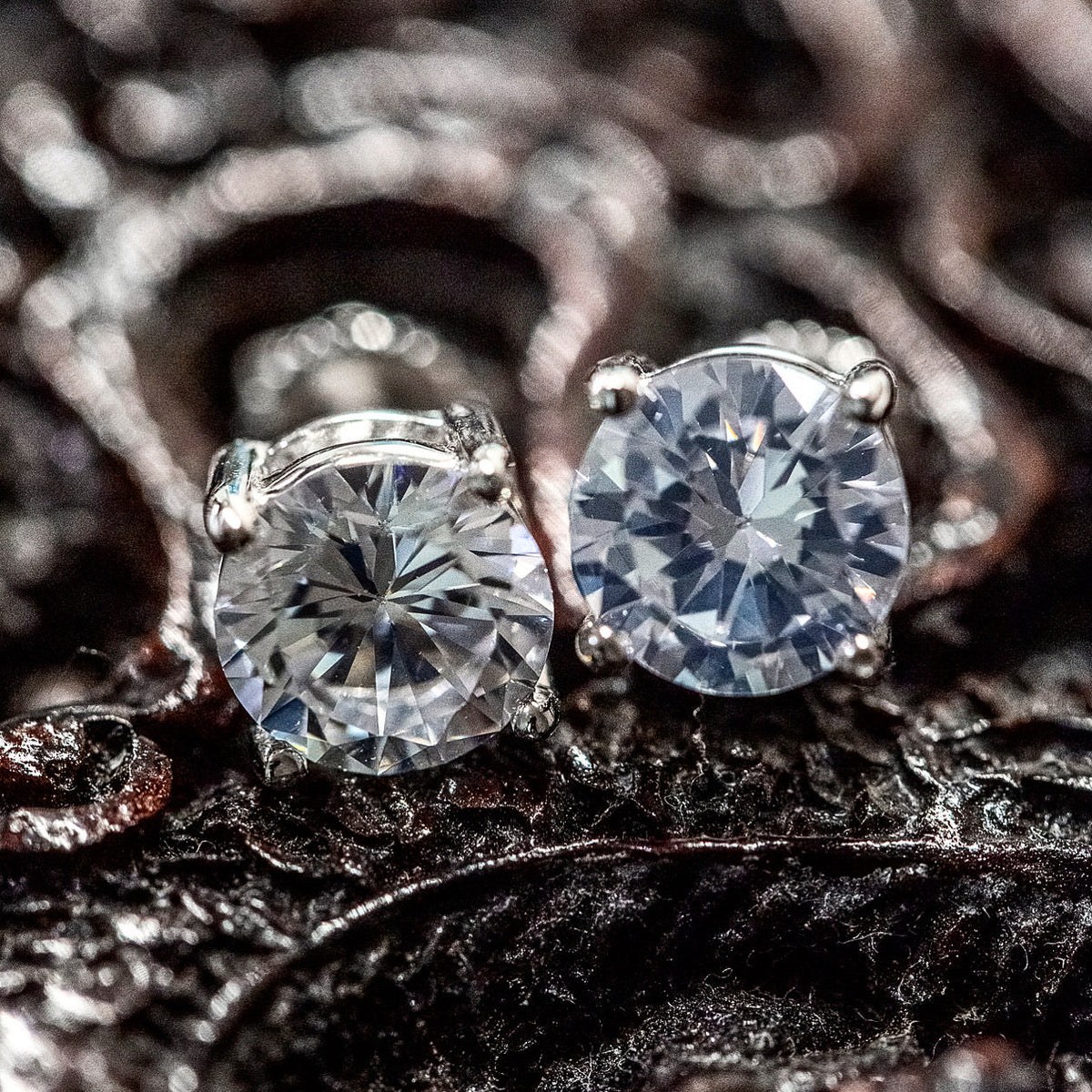
Cubic zirconia in iced-out jewelry comes in grades from low (cheap costume) to high (5A grade, premium). High-grade CZ in well-cut stones is genuinely indistinguishable from diamond at arm's length without specialist equipment.
Where you find it: 95 percent of hip-hop jewelry under 500 dollars uses 5A grade CZ. SKRT uses 5A CZ across the range.
Moissanite
Moissanite is a synthetic stone made from silicon carbide, originally discovered in meteorite fragments. It is harder than CZ, more brilliant than diamond, and roughly 5 to 10 percent the cost of natural diamond.
Properties:
- Hardness: 9.25 on the Mohs scale (harder than CZ, softer than diamond)
- Refractive index: 2.65 (higher than diamond)
- Visual: more "rainbow fire" than diamond due to higher dispersion
Moissanite is the trade-up choice from CZ. It looks brighter than diamond in many lighting conditions, costs significantly less, and outlasts CZ.
The "tell" with moissanite is the rainbow flash. Under direct sunlight, moissanite throws more colored light (rainbow flares) than diamond. Some people love this. Others want diamond's pure white sparkle.
Where you find it: hip-hop pieces in the 500 to 2,000 dollar range often use moissanite for the visible-stone areas. SKRT pieces use 5A cubic zirconia across the range.
Lab-grown diamonds
Lab-grown diamonds are diamonds. Same chemical composition (pure carbon), same crystal structure, same physical properties. The only difference is they were grown in a controlled laboratory over weeks rather than formed underground over millions of years.
Properties:
- Hardness: 10 on the Mohs scale (true diamond)
- Refractive index: 2.42
- Visual: identical to natural diamond, indistinguishable without specialized equipment
Lab diamonds cost roughly 30 to 50 percent of equivalent natural diamonds. The supply is steady (no mining constraints), the quality is more controlled (lab process is more uniform), and the carbon footprint is significantly lower.
Where you find them: high-end custom pieces often use lab diamonds for major stones. Center stones in pendants, large prong-set stones in cuban links, statement piece focal stones.
How to tell which one is in your chain
Three quick tests:
- The diamond tester. A pen-shaped device that measures thermal conductivity. Diamond and moissanite both pass. CZ fails. Cost: roughly 25 dollars on Amazon.
- The moissanite tester. Tests electrical conductivity in addition to thermal. Moissanite passes; diamond also passes but registers slightly differently. Most modern testers do both in one device.
- The seller's spec sheet. Reputable sellers state stone material on the product page. Hidden specs equal hidden corners cut.
If a piece is sold as "diamond" without specifying lab vs natural, and the price is below 5,000 dollars for an iced-out cuban or tennis chain, the math doesn't add up. Either the stones aren't diamond at all, or the seller is taking a heavy loss.
What SKRT uses
SKRT keeps the stone choice simple:
- Every SKRT piece: hand-set 5A grade cubic zirconia, the highest CZ grade
Every SKRT product page states which stones are used. We do not market CZ pieces as "diamond" pieces. Honesty about materials is the foundation of trust.
Pro tip: at hip-hop jewelry price points, stone cut quality matters more than stone material. A poorly-cut diamond looks duller than a well-cut moissanite. A poorly-cut moissanite looks duller than a well-cut 5A CZ. Cut quality is what makes ice look like ice.
Bottom line
CZ for entry-tier pieces, moissanite for mid-tier, lab diamond for premium. None of these are "fake" if the seller discloses what they are. The lie is when sellers market CZ as "diamond" at premium prices.
See SKRT's iced-out collection for material-spec details on every piece.
SKRT picks fitting this guide: the 12mm Cuban Link Chain in 18K Rose Gold, the 4mm Tennis Chain in 18K Yellow Gold, and the Iced Out Baguette Cross in 18K White Gold.


Share:
Layering Tennis Chains and Cuban Links: A Visual Guide
How to Travel With Jewelry Without Damaging It